
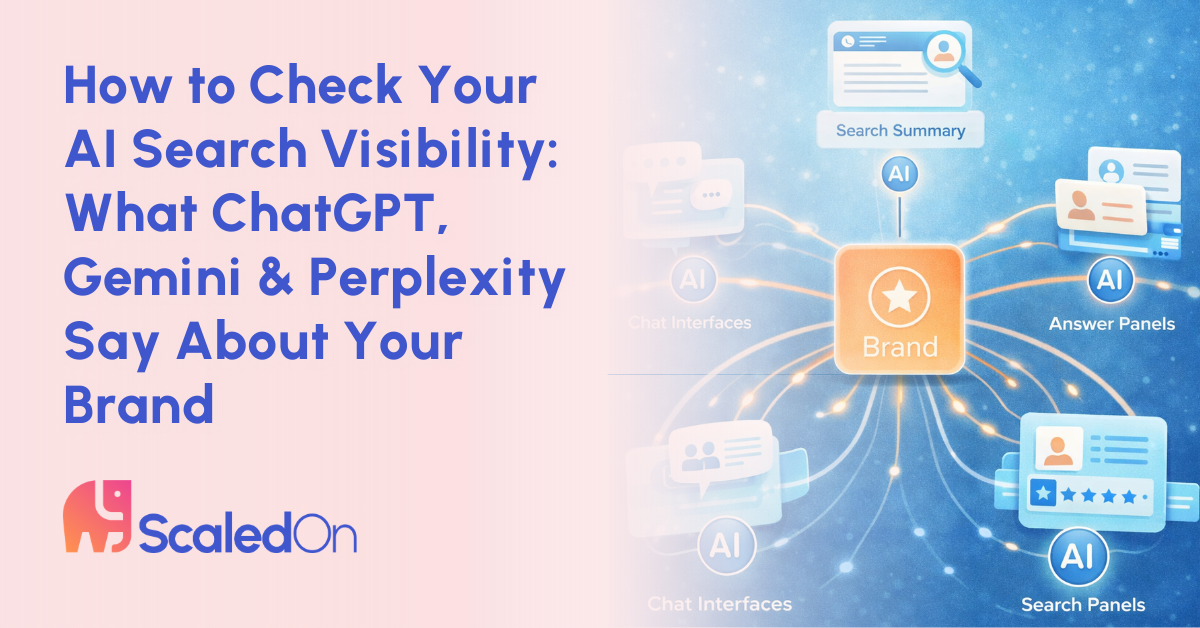
How to Check Your AI Search Visibility: What ChatGPT, Gemini & Perplexity Say About Your Brand
Your customers are asking ChatGPT about your business right now. Here’s how to check your AI search visibility across ChatGPT, Perplexity, and Gemini, and what to do if you’re not showing up.
Your customers now research in AI assistants as well as on Google. When someone asks, “What’s the best [product] for [use case]?” the answer names a short list of brands. If you’re not on it, that buyer may never reach your site.
Where this guide fits: if you just want a quick yes or no for ChatGPT, start with our 10-minute ChatGPT audit. This guide is the next step. It covers checking every major AI engine, reading the patterns, and fixing the gaps yourself.
Plan on about an hour for the check, then work through the fixes in order.
Why AI Search Visibility Matters for Your Business
AI platforms like ChatGPT, Perplexity, and Google AI Overviews have become primary research tools for your customers. Each one builds its answer from different sources, so your visibility can differ from one engine to the next.
Here’s why this matters: when someone researches your product or service on these platforms, they read AI-generated summaries before they ever click a link to a website. If you’re not included in those summaries, you don’t exist to that buyer.
And the shift is getting bigger, not smaller. AI assistants are starting to complete purchases, not just recommend products. Brands these systems already know and trust are better placed if that kind of shopping grows.
Why Your Current Analytics Are Missing the Picture
If you’re managing your marketing with traditional web analytics, there are a few specific ways your dashboard is now misleading you.
Clicks don’t measure influence.
When someone reads an AI-generated answer that pulls from your content without clicking your site, your analytics show nothing. But you influenced their decision. That gap between influence and credit is getting wider every month.
Traffic doesn’t equal market presence.
Your content could be shaping how thousands of people think about your product category every day without generating a single visit in Google Analytics. Your dashboard shows zero.
Your reports usually credit the final click, not the first answer.
Today’s buyers check AI assistants, Google, review sites, YouTube, and email before they’re ready to buy. Standard reports give all the credit to whichever link they clicked last, even when an AI answer is what put your business on their shortlist in the first place.
For businesses running both paid and organic marketing, this creates real budget problems. You may be under-investing in the pages that answer buyer questions early, while giving all the credit to whichever link or ad the customer clicked last.
How AI Search Affects Your Industry Specifically
Not every industry is affected the same way.
- E-commerce brands face shoppers who ask ChatGPT, Gemini, and Perplexity to compare products and recommend which one to buy before they ever visit a store.
- Amazon sellers selling on both Amazon and their own website run into the same blind spot. When a buyer researches on ChatGPT, compares options on your website, and buys on Amazon, your reports only see the Amazon sale and miss the ChatGPT recommendation that started it.
- Educational institutions see AI summaries on many of the question searches prospective students run while comparing programs. A student researching graduate programs often reads an AI-generated answer before visiting a school’s site. If you’re not part of those summaries, you miss that early shortlist.
- Healthcare providers and professional service firms face similar dynamics. When patients research treatment options or businesses evaluate service providers, they’re getting AI answers first. Being cited builds credibility before the prospect ever reaches your website.
- Multi-location businesses now compete with AI-generated local answers that sometimes bypass the traditional map results entirely. Local visibility increasingly requires being cited in AI responses, not just ranking in map listings.
The same pattern applies across industries: citations amplify your visibility, and absence hurts your revenue.
How AI Platforms Actually Decide What to Show
Before you can improve your AI search visibility, it helps to understand how these systems decide what to recommend.
When someone asks ChatGPT a question like “What’s the best email marketing platform for small e-commerce businesses?”, it often doesn’t run a single search. Behind the scenes, it breaks that question into several smaller follow-up questions and searches each one separately. That is why targeting a single keyword isn’t enough anymore: your pages need to answer both the main question and the practical follow-up questions a buyer asks next.
Each platform also behaves differently:
- ChatGPT answers from what its model learned in training and, when it searches the web, from live results it links as sources. It also shows shopping results for product questions.
- Perplexity searches the web for nearly every answer and shows its sources prominently.
- Google AI Overviews draw on Google’s regular search index and ranking systems. Google says there is no special markup required to appear, so ordinary SEO health still matters here.
- Claude and Microsoft Copilot can also search the web, and each picks sources its own way.
- Gemini is connected to Google Search and Google’s wider shopping and maps data.
The important takeaway: generic “AI optimization” doesn’t exist. What gets you cited on ChatGPT won’t necessarily work on Perplexity. And what works today might shift next month. These platforms are evolving quickly.
How to Check Your AI Search Visibility Across Every Engine (Free)
You don’t need a paid tool to begin. Checking by hand gives you a baseline now and tells you whether a tool is worth paying for later.
Step 1: Build Your Prompt List
Use the four question types from the 10-minute ChatGPT audit: branded, category, comparison and problem questions. It has copy-paste templates and examples for each one. Write 20 to 30 prompts in the words your customers use, and keep them in a spreadsheet with the prompt, the question type and the date you tested it.
If you already ran the 10-minute audit, reuse the same prompts so your ChatGPT results and your other-engine results line up.
Step 2: Test Each Platform
- On ChatGPT (chatgpt.com): Is your brand mentioned in the response? Where does it appear? (First, middle, buried, or absent?) Does ChatGPT link to your website as a source?
- On Perplexity (perplexity.ai): How many sources does the answer include? Is your brand one of them? How is your brand described? (As an authority, as one option among many, or as a passing mention?)
- On Google AI Overviews: Search your prompts in Google. Look for the AI-generated summary at the top (not all queries trigger one). Note whether your brand appears in the summary.
- On Gemini (gemini.google.com): Test with and without “Search the web” enabled. Note whether the citations change.
- On Claude (claude.ai): Check whether your brand is mentioned without you explicitly asking for it. Note the context and how you’re framed.
Step 3: Document What You Find
- Mention: Yes or no
- Position: First mention, middle, buried, or absent
- Citation: Is your site linked as a source?
- Framing: How are you described?
- Competitor presence: Who else appears, and how are they positioned?
- Accuracy: Is the information correct and current?
To track progress over time, score each prompt on every engine: 3 for a first mention with a link to your site, 2 for a mention with a link, 1 for a mention with no link, 0 for absent.
Step 4: Look for Patterns
- Which platforms cite you most often?
- Which types of questions trigger mentions?
- Where do competitors consistently appear when you don’t?
- Are the mentions accurate, or is AI citing outdated information about your business?
These patterns tell you where to focus. If competitors show up every time a buyer asks AI to compare options and you don’t, you are losing those sales. If ChatGPT consistently cites you but Perplexity doesn’t, that points to something specific about how your pages are written or how well-known you are in your industry.
The Limits of Manual Checking
- It takes more time than it sounds. Testing a few dozen prompts across five engines takes a few hours, and it adds up if you repeat it every month.
- AI answers vary from one check to the next, meaning the same question can produce a slightly different answer each time. You’re seeing one response, not a fixed ranking. Run your most important questions two or three times before you draw conclusions.
For most businesses, checking by hand reveals whether you have a problem. Next comes fixing what you find.
What to Do About the Gaps You Find
Let’s say you’ve checked your AI search visibility and confirmed you have a problem. Competitors appear in AI responses and you don’t. Here’s how to fix it.
Make Sure Your Website Is Not Locking AI Tools Out
Before you rewrite a single page, make sure AI tools can actually read your website. First, check that your most helpful guides, pricing explanations, and FAQs live on regular public pages rather than behind login walls, email sign-up gates, or pop-up overlays. Second, forward the checklist below to the person who manages your website hosting so they can make sure your site isn’t blocking AI search tools behind the scenes.
Send this to your web person
Ask your developer, IT contact, or hosting provider to verify these three settings:
- Check
robots.txt: Confirm yourrobots.txtfile allows major AI search crawlers:GPTBot,OAI-SearchBot, andChatGPT-User(OpenAI/ChatGPT),ClaudeBot(Anthropic),PerplexityBot(Perplexity),Meta-ExternalAgent(Meta), andGooglebot/Google-Extended(Google). - Check CDN and firewall rules: Some hosting providers and CDNs (including Cloudflare) block AI crawlers by default. Confirm your security rules allow the crawlers above to fetch public pages.
- Check page rendering and structured data: Confirm core page copy, product specs, and FAQs load in the initial HTML response, and that
Organization,Product, orServiceschema matches the visible page facts.
Make Your Pages Easy to Quote
- Lead with your answer. Don’t bury the main point. State it clearly in the first paragraph, then provide the context and details underneath.
- Use clear headers. Question-based headers work especially well because they match how people actually ask things. “How does X work?” as a header is more useful than “Overview of X.”
- Use bullet points and numbered lists where they make sense. AI tools favor clear lists and tables they can read and quote without guesswork.
- Write for someone skimming, not just someone reading every word. This isn’t dumbing down your content; it’s making it more useful for both AI and the humans who eventually read the AI’s response.
Get Mentioned on Sites Your Buyers Trust
AI answers lean on what other sites say about you, not only on your own pages.
- Share real customer examples and numbers on your site so AI tools have concrete proof to quote
- Earn mentions in trade associations, local press, and industry directories your customers already trust
- Keep customer reviews current on Google, Clutch, or industry review sites that AI tools check when comparing providers
- Answer every common buyer question clearly on your service and product pages so AI tools recognize what you do and who you serve
None of this is about gaming the system. It’s about giving both buyers and AI tools clear proof of what you do.
Give AI Shopping Tools the Exact Product Facts
Vague product slogans don’t help when a buyer asks an AI tool to compare options. AI shopping tools look for concrete facts they can compare side by side.
- Vague marketing copy: “Premium ergonomic standing desk with whisper-quiet motor and memory presets for the ultimate work-from-home experience.”
- Clear for AI tools: “Electric standing desk, height adjustable 29 to 48 inches, weight capacity 275 lbs, dual motor, 4 memory presets, 60 x 30 inch surface, assembly time 30 minutes, 5-year warranty.”
The second version gives AI agents the specific, comparable data they need to match your product to what a user is looking for. If AI shopping keeps growing, clean product data is what lets these tools match you to a buyer.
Three Mistakes That Kill AI Search Visibility
These are the patterns we see most often when businesses try to improve their AI visibility and don’t get results.
-
1. Writing Pages Around Short Keywords Instead of Real Buyer Questions
Buyers ask AI tools full questions about prices, timelines, compatibility, and comparisons. If your service or product pages only repeat broad slogans and never answer those specific questions in plain language, AI tools will quote a competitor whose page gives a direct answer. -
2. Accidentally Locking AI Tools Out of Your Website
Default website security settings and hosting rules often block AI tools without the business owner realizing it. If your website blocks those tools from reading your pages, nothing else you do on this list will show up. Send the “Send this to your web person” box above to whoever manages your website hosting so they can check it in five minutes. -
3. Publishing Vague Pages With No Specific Proof
Pages that only repeat generic claims give AI tools nothing concrete to cite. AI tools look for specific facts: exact service areas, product specs, pricing ranges, credentials, and real customer results. Put the real numbers and details on your pages that a buyer would hear if they called your best salesperson.
Frequently Asked Questions
Does appearing in AI results increase or decrease my traffic?
It depends on whether you’re cited. People tend to click fewer links when an AI summary appears, so being one of the sources the summary names matters more than it used to. See what answer engine optimization is for the research on this.
How do I know if I’m being cited in ChatGPT or Perplexity?
The most reliable approach right now is testing your buyer questions directly on each platform in a logged-out browser window and recording whether your business is named and linked. Google Search Console includes AI Overview clicks inside its overall web search totals rather than breaking them out in a separate report, so running your prompt list monthly or quarterly is the clearest way to see progress.
Is this just a problem for e-commerce brands?
No. This affects any business where potential customers research online before making a decision. Healthcare providers competing for visibility when patients ask about treatment options. Universities competing when students ask ChatGPT about programs. Professional service firms where buyers research extensively before reaching out. Multi-location businesses where local queries now generate AI summaries. The specific dynamics differ by industry, but the core shift is universal.
Do I need to do anything different for ChatGPT than for Google’s AI answers?
Yes and no. The underlying principles overlap: clear pages, mentions on trusted sites, and direct answers to buyer questions. But the details matter. Google AI Overviews use Google’s normal search results, so traditional ranking still matters there. ChatGPT and Perplexity show the sources they searched, so you can see which pages they trust for each prompt. Fixes aimed at one tool can help, but only after the basics are in place. Without them, those extra fixes won’t help.
Will AI search go away or get rolled back?
No. ChatGPT, Perplexity, Gemini, and Google are all investing heavily in AI answers. The question isn’t whether AI search will stick around. It’s whether your business will be visible in it.
How long until AI tools start mentioning my business?
Fixes to your site can show up within weeks. Getting mentioned on other sites takes longer, often months. Ask the same questions again every month so you can see real movement.
Too busy, don’t know how, or don’t want to fix it yourself? We can help
If you’d rather not run the checks and fixes yourself, start with an Opportunity Review. Before any conversation about working together, we look at your real numbers and run the questions your buyers ask through ChatGPT, Gemini, Perplexity, Claude, and Google AI Overviews. We show you where competitors are named instead of you and what is holding your visibility back, at no cost and with no obligation. The findings are yours to keep. If you want ongoing help, that is what our answer engine optimization service does.
See What’s Holding Your Marketing Back