
On May 19, at its annual I/O conference, Google announced what it called “the biggest change to the search entry point in more than 25 years.” Most business owners did not see it covered in mainstream media. Most marketing agencies have not explained it yet. Here is what actually changed, and what to do about it.
Google Just Rebuilt Search. Here Is What Changed.
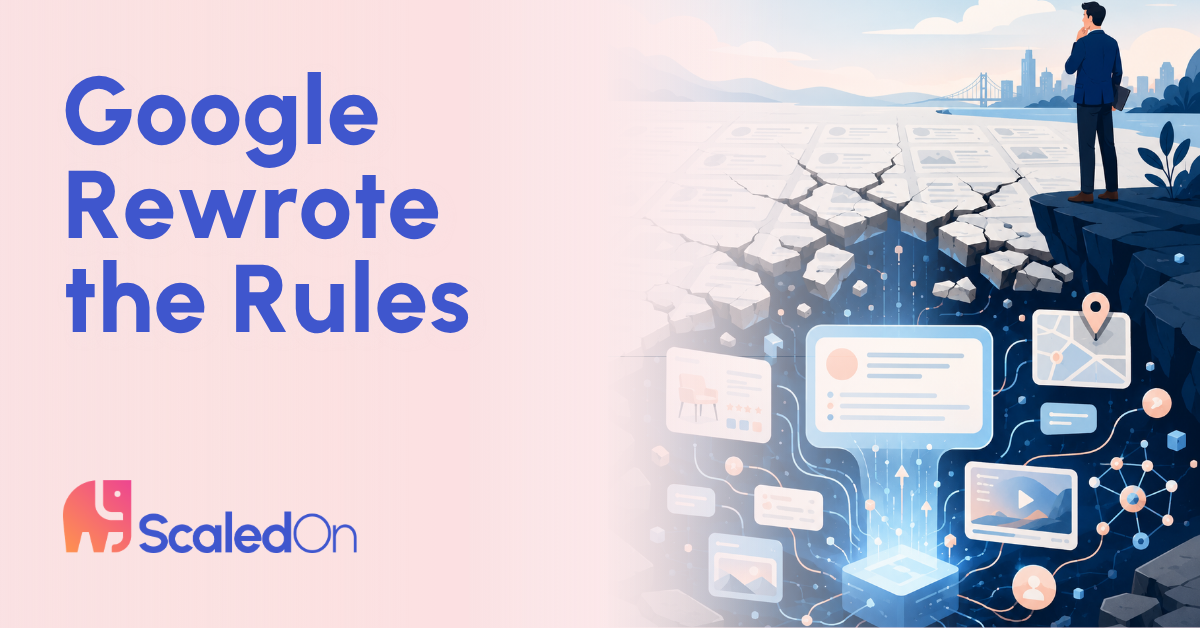
The search engine most businesses have built their marketing around, a ranked list of links to websites, is being replaced by something fundamentally different. Google confirmed it directly: links are “no longer the priority for many types of searches.” That is not an algorithm penalty. It is a design decision, and it is already affecting organic traffic across industries.
Four things changed at I/O 2026. Each one reduces the likelihood that a potential customer reaches your website through organic search.
The new search box (live now)
Google’s search interface now expands to accommodate long, conversational questions. AI-powered suggestions guide users toward more complex queries, going far beyond traditional autocomplete. Users are shifting from short keyword strings to natural language. Content built for keyword matching is becoming less effective at capturing that traffic.
Google AI Overviews and Google AI Mode (already large, still growing)
Google AI Overviews now reach 2.5 billion monthly users. Google AI Mode, the platform’s conversational search experience, has 1 billion monthly users. Both answer questions directly on the search page before a user clicks any link. Your rankings can hold while your clicks fall, because fewer users are reaching the link results at all.
Generative UI (arriving this summer)
Starting this summer, Google will build custom interactive experiences directly in search results: dynamic layouts, visualizations, and stateful project spaces tailored to each individual query. For certain searches, a user will get a complete, actionable answer without visiting a single website. Your content either feeds that experience or it is absent from it.
Information agents (arriving this summer, the most underreported change)
This is the announcement most business owners have not heard about, and it carries the furthest-reaching implications.
What Is Google AI Mode, and What Are Information Agents?
Google AI Mode is Google’s conversational search experience, currently used by 1 billion people per month. Instead of returning a list of links, it synthesizes an answer from across the web and presents it directly. Users can ask follow-up questions, refine their query, and get deeper answers, all without clicking to an external site.
Information agents take this further. Starting this summer, Google users will be able to create background AI agents that monitor the web on their behalf, around the clock. A prospective customer could set up an agent to track “best [product] for [use case]” or “most reliable [service provider] in [city]” and receive a synthesized recommendation before they ever open a browser to search manually.
Google’s head of Search described these agents as systems that “map out a monitoring plan, track changes, and provide a synthesized update with links.” The businesses those agents recommend are the ones with content specific, sourced, and authoritative enough to cite with confidence. The businesses they do not recommend are invisible at that layer of the buying process.
The old model: a customer has a question, opens Google, clicks a link, lands on your website. The new model: an agent monitors on the customer’s behalf, synthesizes a recommendation, and the customer acts on what the agent delivers. You may never receive a click at all.
Who Is Getting Hit Hardest
The businesses most exposed are those whose content was built for the old system: keyword-optimized pages that cover topics broadly but without the specificity or authority an AI system can confidently cite.
Informational content has been hit hardest. Service and product pages with strong purchase intent have some protection, but they are not immune. Local businesses face additional exposure: AI systems synthesize local recommendations from reviews, Google Business Profile data, and directory listings, not necessarily from a business’s own website. Thin location pages and incomplete GBP profiles effectively remove a location from AI-generated recommendations.
The test is simple. Open ChatGPT, Perplexity, or Google AI Mode and ask it to recommend a business like yours in your market. If you are not mentioned, that is your visibility gap.
What Business Owners Should Do Now
The goal is no longer ranking on page one of Google. The goal is being the source AI systems cite when they build a recommendation, whether for a user actively searching or for an agent monitoring on their behalf.
That requires authority, not volume. Almost every website we review has more content than it needs and less authority than it requires. The problem is specificity: content that covers a topic without saying anything definitive enough for an AI to cite with confidence.
What authority-first content looks like in practice:
- FAQ sections with real, specific answers rather than “it depends”
- Case studies with named outcomes and measurable results
- Content that cites data with sources, not general industry claims
- Named experts with visible credentials and professional histories
- Location pages with real operational detail, not copy-pasted text across locations
This approach has two names in the industry: Answer Engine Optimization (AEO) and Generative Engine Optimization (GEO). Both describe the same shift: build content for how AI systems evaluate and cite sources, not just for how keyword algorithms ranked pages.
Google Changed Search. Here’s What to Do About It.
ScaledOn founder Alec Newcomb, who has been in search since the earliest days of the industry, sits down with Director of Marketing Courtney Kotulak for a 30-minute session on exactly this topic. The conversation includes applied examples for product brands, service businesses, and education programs.
Sources: TechCrunch, Sarah Perez, May 19, 2026. Google I/O 2026 press briefing. DataForSEO, May 2026.
Need help making sure your business shows up in AI search results?
Contact ScaledOn to see how we help businesses stay visible in a world where AI answers before customers click.
👉 Contact ScaledOn