
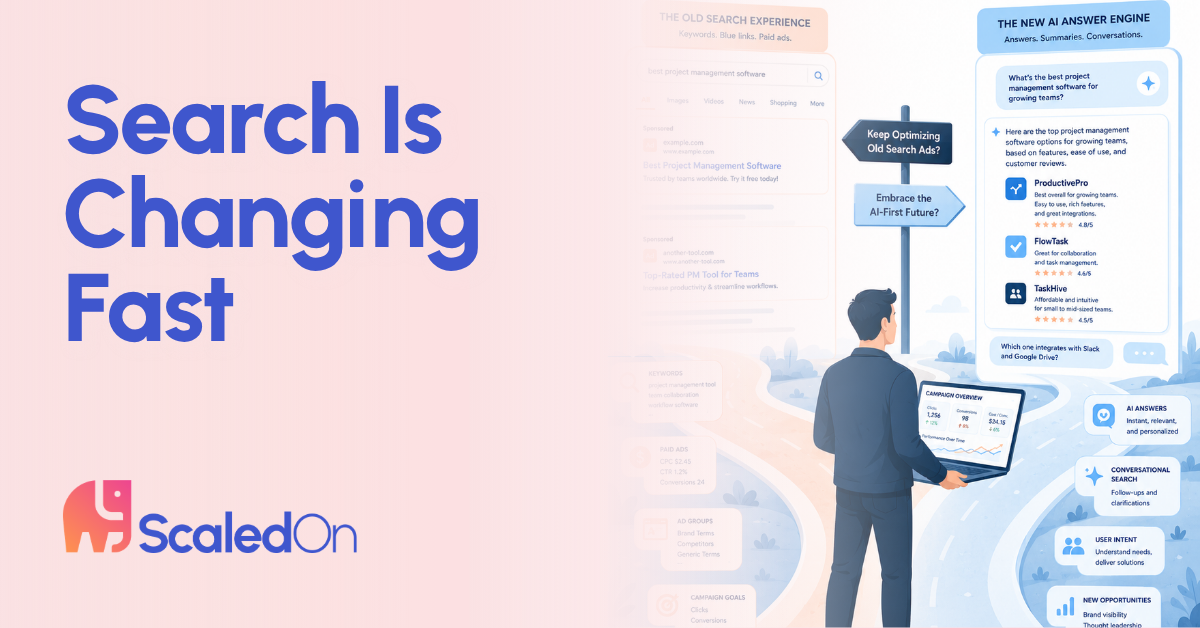
If your business runs Google Ads, something significant happened in May. Google announced a new set of ad formats built for its AI-powered search experience. These aren’t small changes to ad placement or pricing. They represent a shift in what a search ad can do and, more importantly, where it can appear.
The problem for most businesses: the campaign structure required to access these formats is different from what most accounts are currently running.
The Way People Search on Google Is Changing Fast
Over the past two years, Google has been rebuilding search around AI. The centerpiece is AI Mode, a conversational search experience launched in 2025. Instead of a page of links, AI Mode gives people direct answers, comparisons, and recommendations, generated in real time.
That experience now has more than 1 billion monthly users (Google, May 2026). When someone asks a detailed question about a product or service, they’re increasingly getting an AI-generated response rather than a list of sites to scroll through.
Most standard Google Ads aren’t built to appear in that experience. They’re built for the traditional results page. That’s a different place, and its share of searches is shrinking.
What Google Announced in May, in Plain Terms
Google introduced four new ad formats at its annual advertising event. Here’s what each one actually does:
- Conversational Discovery ads: Your ad can now respond to a specific question rather than showing the same generic copy to everyone. If someone searches for a detailed, situational query, the ad content adapts to what they’re actually asking.
- Highlighted Answers: When AI Mode returns a recommendation list for a category or need, businesses can now appear as a sponsored entry on that list. Before this, there was no paid placement in AI recommendation lists at all.
- Business Agent for Leads: Instead of sending someone to a contact form, this format puts a chat button directly inside your ad. A prospect can ask questions and get answers drawn from your own website content, without leaving the search page. No form. No waiting. Google builds the agent from your site automatically. This is in open beta in the US now, starting with automotive, education, and real estate, with more categories to follow.
- AI-powered Shopping ads: For product searches, Google’s AI generates a custom explanation of why a specific product fits that buyer’s situation, alongside the product listing. Coming to the US later in 2026.
The Part That Matters Most for Your Budget
These formats are not available to every Google Ads account automatically. Access requires that your campaigns be running Google’s current AI-driven campaign structures: AI Max for Search, or Performance Max with text customization enabled. Accounts still running older standard campaign types are locked out.
This is where the gap shows up. Campaigns built two or three years ago, even ones that have performed well, may be running a structure that blocks access to everything announced in May. It’s not about budget. It’s about how the campaigns were set up.
Most business owners don’t know which structure their account is running, because it’s not something you’d check day to day. But it’s the difference between being eligible for the new formats and not.
Not Sure What Your Campaigns Are Set Up For?
We look at Google Ads accounts regularly and can give you a clear picture of where yours stands: what structure you’re running, what formats you can access, and where the gaps are. No obligation.
👉 Request a Free Opportunity ReviewWhat This Means if You’re a Service Business
The Business Agent for Leads format deserves specific attention if your business is one where buyers typically have questions before they commit. Professional services, home services, healthcare, financial services, any business where the sale starts with a conversation rather than a purchase.
The current process most businesses rely on: someone sees your ad, clicks to your website, finds your contact form, fills it out, waits for a response. Every step loses people.
Business Agent for Leads shortens that sequence. The prospect stays on the search page, asks their question, gets an answer from your website content, and moves closer to a decision before they’ve even clicked through to your site. The lead that comes through has already had a conversation.
This format is in beta in the US today, limited for now to automotive, education, and real estate advertisers. Other categories will follow as the beta expands. It won’t be widely available immediately, but the businesses with the right campaign foundation in place when it rolls out fully will be first to use it.
Where Most Businesses Are Right Now
The honest reality is that most business owners don’t know whether their Google Ads account is positioned for what’s coming. A lot of the changes Google made over the past 18 months happened without much fanfare, and unless someone is actively managing and auditing the account, it’s easy to be running an outdated structure while still seeing activity and spend.
The gap between campaigns built for traditional search and campaigns built for AI search is widening. Closing it now means going into the rest of 2026 with access to formats that will be available to fewer businesses than you might expect.
Want to Know Where Your Google Ads Stand?
We’ll take a look at your account and walk you through exactly what we find: what structure you’re on, what you’re eligible for, and what’s worth changing. It takes about 30 minutes and costs nothing. If there’s a clear opportunity, we’ll show it to you.
👉 Request Your Opportunity ReviewGet Updates Like This Before They Affect Your Budget
We track what’s changing in Google Ads, paid social, and Amazon advertising and send a short newsletter to business owners who want to stay ahead of it. No jargon. No filler.
👉 Sign Up for the ScaledOn Newsletter