
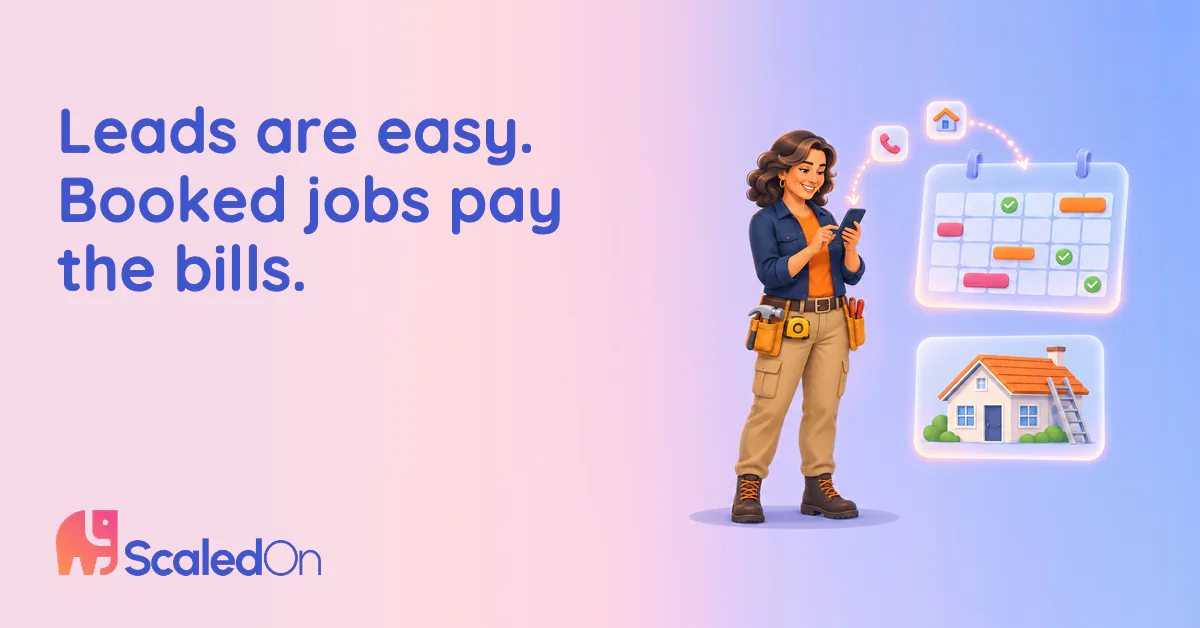
Getting plenty of leads but not enough jobs on the calendar? You are not alone. More leads do not help if they never turn into appointments, and spending more on ads does not help if nobody can tell which ads booked the work. The question that matters to an owner is simple: how many jobs did my marketing book?
This guide is for owners and general managers of windows, doors, siding, roofing and remodeling companies. It shows where jobs usually slip away, what good home improvement marketing does differently, and five real results from companies like yours.
Where home improvement companies lose jobs
Ads that bring in clicks, not homeowners ready to buy
An ad can get plenty of clicks from people who will never hire you: someone looking for a small repair when you only do replacements, someone outside your service area, or someone just looking for ideas. Every one of those clicks costs money.
Slow follow-up
A homeowner who fills out a form is often asking two or three companies at once. If you call back tomorrow, someone else may already have the appointment. Leads go cold in hours, not days.
No clear way to tell which ads booked jobs
Most ad reports stop at the form fill or the phone call. They do not show which of those turned into an appointment, and which appointments turned into a signed job. Without that, the ads keep chasing the cheapest lead, not the best one.
Spending more when the fix is spending smarter
When work slows down, the first instinct is to raise the ad budget. Often the better move is to fix where the money is leaking first, so each dollar you already spend books more jobs.
The 60-second check
Pull up last month’s numbers and answer three questions:
- How many leads came in?
- How many of those became booked appointments?
- How many appointments became signed jobs?
If you can answer the first but not the other two, your marketing is being judged on leads alone. That is the most common gap we see, and the easiest place to start.
Can only answer the first question? Want us to take a look? We’ll show you where leads stop turning into booked jobs.
See What’s Holding Your Marketing BackWhat good home improvement marketing does differently
- It aims ads at homeowners ready to buy. It cuts searches and audiences that never turn into your kind of job.
- It follows up fast with email and text. New leads hear back quickly, and older leads and past customers get regular, useful reminders.
- It tracks appointments and sales, not clicks. The ad platforms are told which leads became real jobs, so they find more people like them.
- It adjusts by service, town and season. Roofing in spring, windows before winter, and more money in the towns where you close the most work.
Real results from home improvement companies
These are published ScaledOn case studies. Each result is quoted as it appears on the case study page. Every company is different, and these are not a promise of what yours will see.
Google Ads (Performance Max): a windows and doors company
The problem: “A windows and doors company was getting cheaper leads, and fewer of them were turning into sales.”
What changed: The company’s customer records were connected to Google Ads, so Google could see which leads became appointments and closed deals. The ads were then set to aim for booked appointments and the value of closed deals, instead of form fills and call clicks.
The result: “3.08x Return on ad spend vs. 2.5x on Google Search.” Return on ad spend means how much money came back in sales for every dollar spent on ads. Read the windows and doors case study.
Email and text: a windows, doors, siding and roofing company
The problem: The company was emailing its list, but the emails produced almost no attributed sales.
What changed: The program reached the whole list, then split it into groups including past buyers, quoted leads who had not signed, and leads nobody had reached. From 2026 it sent one offer each month, and text messages joined in March.
The result: “7.7x Closed sales value,” “17.8x Booked appointments” and “75.6% Lead-to-appointment rate up from 46.9%,” first program year compared with the year before. Read the email and SMS case study.
Google Ads: a roofing contractor
The problem: Much of the budget went to people who were never going to replace a roof.
What changed: Tracking was fixed so every real lead was counted once, the landing page was rebuilt around getting an estimate, and searches for minor repairs, commercial flat roofs and do-it-yourself tutorials were cut.
The result: “+85.7% Leads in 30 days, on a lower budget,” “-67.7% Cost per lead” and “2x Conversion rate.” Cost per lead is what you pay in ads for each estimate request. Conversion rate is the share of paid visitors who asked for an estimate or called. Read the roofing Google Ads case study.
Facebook ads: a roofing replacement contractor
The problem: The ads were running, but tracking errors counted some form fills twice, so the ads were learning from numbers that were not real.
What changed: Tracking was corrected, the estimate page was simplified and made faster on phones, and four ad angles were tested, all on the same budget.
The result: “+42.9% Leads same budget, under $3,000” and “+66.1% Conversion rate month over month.” Read the roofing Facebook ads case study.
Google Ads and conversion work: a renovation company
The problem: A steady ad budget, but flat results, lead volume that had stalled, and conversion tracking that could not be fully trusted.
What changed: Seasonal offers matched to updated landing pages, better audience targeting, and conversion tracking that was cleaned up so the numbers could be trusted.
The result: “Conversion Rate Jumped from 39.57% to 64.44%” after the tracking and audience fixes, and “Lead Volume Rose by 174%” from February to March. Read the renovation case study.
You can find more on our success stories page.
Follow-up is where most jobs are won
The email and text case shows the leak that most companies miss. The leads were already there. What changed was what happened after they came in. The share of leads that became booked appointments went from 46.9% to 75.6%.
A few things made the difference:
- Past buyers got their own messages. They brought in the most sales value per email of any group on the list.
- Quoted leads who had not signed got follow-up. A homeowner who got a quote and went quiet is often still deciding.
- Timing matched the sales cycle. The program was measured over the weeks it takes a deal to close, not just the day the email went out.
See how our email marketing services handle this kind of follow-up.
Fix it yourself: four things to do this month
- Call new leads back within the hour. Set a rule for your office and track it for two weeks.
- Write down every lead’s outcome. Booked, not booked, signed or lost, in your CRM or a simple spreadsheet.
- Email or text your past customers once a month. A seasonal reminder or offer is enough to start.
- Look at the searches your ads show up for. In Google Ads, the search terms report shows what people typed. Cut the ones that are never your kind of job.
Send this to your web person
If someone else manages your website or ads, send them this:
Hi, could you check a few things for us?
- Confirm each form fill and phone call from our website is counted once in Google Ads and Facebook, with no duplicates (Google Tag Manager and the Meta Pixel).
- Tell us whether our CRM is connected to Google Ads so it can see booked appointments and closed jobs (offline conversion import), and what it would take to set it up.
- Run our estimate page through Google PageSpeed Insights on mobile and send the results.
- Send us the Google Ads search terms report for the last 60 days, with spend for each term.
Thank you.
Where search and AI fit
Homeowners also search Google and ask AI tools like ChatGPT for a local company they can trust. Clear pages for each service and the areas you serve, plus steady reviews, help your ads and follow-up work better, because people check you out before they call. For more, see our local SEO audit checklist and our list of the best local SEO agencies for home services.
A pattern from one home improvement client
For one home improvement company we work with, the homepage brought in the largest share of leads from search. Beyond the homepage, two kinds of pages stood out for bringing in leads:
- Service pages. A page for each main service, plus a page for the areas you serve. A homeowner searching “window replacement in [your town]” should land on a page about exactly that.
- Practical guides that answer a real homeowner money or project question. For example, a guide to the tax credits and incentives for new windows in your state.
For that company, the tax-credit guide brings the most leads of any blog post; most popular how-to posts bring few. A guide like that reaches homeowners who are planning a purchase, while a popular how-to post can draw plenty of readers who never ask for an estimate. If you write for your website, write the guide your customers need before they buy.
How to choose a home improvement marketing company
Ask these questions before you sign:
- Do you report booked appointments and sales, or just leads?
- Who does the work, and can I talk to them directly?
- Do I own my ad accounts and data? You should, and they should stay with you if you leave.
- How do you decide where the budget goes? Look for answers about services, towns and seasons, not just “more spend.”
Red flags:
- Long lock-in contracts.
- Reports that only show clicks and impressions.
- Promises of a set number of leads or jobs.
If Google Ads is your main channel, our post on Google Ads for home services in 2026 covers what changed this year.
How ScaledOn works with home improvement companies
ScaledOn runs Google Ads, Performance Max, Facebook ads, email and text follow-up, and tracking for home improvement companies. You work directly with the specialists running your ads and follow-up, with no go-between. We report on appointments and sales, not just clicks. No long-term contracts. See how we work on our home improvement marketing page. If your company is in New England, see our home improvement marketing for New England companies page.
Too busy, don’t know how, or don’t want to fix it yourself? We can help
Getting leads but not enough booked jobs? We will look at your ads, your follow-up, and your tracking, and tell you plainly where jobs are slipping away.
We run the analysis before any conversation about working together.
See What’s Holding Your Marketing BackFAQ
What is the best way to market a home improvement company?
Aim your ads at homeowners ready to buy in the towns you serve, follow up with every lead fast, keep in touch with past customers, and judge your marketing on booked appointments and signed jobs, not clicks or leads alone.
How do I turn more home improvement leads into booked appointments?
Call or text new leads back quickly, follow up with quoted leads who have not signed, and send regular email and text messages to past customers. In one published ScaledOn case, the lead-to-appointment rate went from 46.9% to 75.6% after a follow-up program started.
Are Google Ads or Facebook ads better for roofers and contractors?
Both can work. Google Ads reaches homeowners who are already searching for the service. Facebook ads reach homeowners who are not searching yet but may be ready soon. Many companies use both and move budget toward whichever books more jobs.
Does email and text follow-up really help contractors book more jobs?
It can. In one published ScaledOn case, a windows, doors, siding and roofing company saw “17.8x Booked appointments” in its first program year compared with the year before. Results vary by company.
What should I ask before hiring a home improvement marketing agency?
Ask whether they report booked appointments and sales, who does the work and whether you can talk to them, whether you own your ad accounts and data, and how they decide where the budget goes. Watch for long contracts and click-only reports.